Monday, May 9, 2016

Postal Requirements for Using eVS Lowered

Do I Qualify to Use USPS eVS?
USPS Electronic Verification System (eVS) allows shippers to process and label packages with postage paid using files transmitted at the end of the day with all the shipping data.

USPS eVS is part of the PostalOne! System and the business requirements are supported by high volume shipping software like Harvey Software’s CPS which is designed with the higher volume shippers in mind.

In the beginning, USPS eVS had package volume requirements of an annual daily average of 200 packages per day. Recently the average daily requirement has been lowered to 50 packages per day or an average of 50 pounds in total package weight shipped daily. This reduction has now made it very appealing to most medium to large volume shippers to consider USPS eVS in the place of using Internet Postage.

USPS eVS eliminates paperwork from old hard copy manifest and postage statements as these have been all replaced with electronic documentation and data uploads created by the certified shipping software used. No third party Internet Postage account is needed when a shipper uses USPS eVS as they deal directly with the Post Office through PostalOne!.
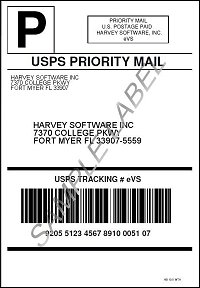

USPS eVS Label from a High Volume Shipping Software Solutions Powered by CPS
Packages are packed, weighed, labelled and have tracking services just like shipping a package with any other carrier. With high volume multi-carrier shipping software systems, like those found at Harvey Software, processing USPS eVS packages can be very fast because there is no Internet Postage access required during package processing. This means package processing can take as little as 1 or 2 seconds to process.

There are many valuable features that surface out of this type of processing in addition to speed and volume efficiency.  For example, if a bad label is created or the package needs to be changed during processing and before it leaves the processing facility, no special handling or postage refunds required. The package is just deleted from within the shipping software used and a new label is reprinted.  Since data is not uploaded to USPS until end of day processing, old incorrect labels can be discarded and new corrected labels created with the correct information.  No more long waits for postage refunds because charges for what is shipped occurs at the end of the day and not when the label is printed.  This is a huge processing speed and financial savings as everyone know things change during processing packages.


Shipping Software Solutions Powered by CPS
USPS eVS makes shipping packages with the US Post Office just like shipping with all the other carriers.  If you have not considered USPS eVS lately and you ship around 50 packages per day you really should be contacting an USPS eVS certified vendor like Harvey Software and let them help you decide if USPS eVS is right for your business.

For more information about USPS eVS for use in high volume shipping software solutions for your business visit http://www.HarveySoft.com.

USPS®, PostalOne!® and eVS® are registered trademarks of the United States Postal Service.

Thursday, April 21, 2016

Not all Shipping Software Systems are Equal


High Shipping Volume Issues?
Harvey Software’s CPS uses two carrier methods to process packages, giving CPS distinct advantages when processing high volumes of packages daily.  This article will explain how these set CPS apart from other shipping systems.

Most multi-carrier shipping software on the market today use carrier provided API’s or Web Services to process packages. These work thru the Internet to communicate with carriers’ servers for each and every package, processed in real-time. It is like you are at the carrier’s shipping counter for each and every package.

These carrier tools are widely used by shipping software and online shipping systems on the market today.  They are easily deployed and updated, with a lower cost to use and maintain. They can work well for many shippers.

Are there downsides to using these tools?  Yes, there can be and these are experienced mostly by higher volume shippers or when the Internet connection has issues pop-up. If the Internet is up and running and the shipper is lucky enough to be in an area where consistently high Internet speeds are available, most companies experience acceptable package processing speeds.  But many companies that sell shipping systems based on API or Web Services state their processing speeds based in a perfect Internet environment.

Let’s face it - there is no such thing as a perfect Internet environment all the time.  Many times everyone is using the Internet all at the same time (like the critical seasonal shipping) and components of these totally Internet based shipping systems can go down.  And down time in shipping is never good.
High Volume UPS and USPS Shipping Software Solutions Powered by CPS

This is the reason that Harvey Software and a few other shipping software providers go to great expense to meet the carrier business rules that allow them to support carrier tools like UPS UPSLink (PLD) or USPS eVS for all packages processed through these carriers.

The advantage is in that both of these carrier services process each package locally throughout the day without needing real-time Internet data moving between the shipper and the carrier for each package. At the close out time, the shipper needs only to upload the carrier package data via the Internet in a single communication.  Best of all, if this quick and simple communication fails for some reason, package shipping is never stopped and close outs can be done at a later time.

The challenge in supporting these direct, locally supported carrier services is that software developers have much more programming involved and meeting business requirements can be very costly.  Every carrier change must be accounted for and be kept up-to-date.  This is why our CPS software checks for carrier updates daily when it starts up and updates the local system in real time.  This extra expense pays off in speed and system stability and is well worth the cost and effort.

The time saved during processing using this process is very noticeable.  Compared to API or Web Services processing, with no Internet needed during the actual shipping process, there is no slowdown of critical package processing.  This means high package volumes are shipped each day on a consistent basis, saving costs and increasing customer satisfaction.

With Harvey Software’s CPS products the shipper still can do all the other operations shippers do with the Internet based online carrier tools.  This includes real-time rating, package processing, communicating package data between in-house systems, tracking, sending shipment notifications, and even support of custom carrier rates.  Packages are processed faster and at a more consistent speed, which is very important for most shippers.


Shipping Software Solutions Powered by CPS
Speed and consistency are the start, but not all.  For example, if a label is printed wrong or the shipping method needs to change, that process is also handled locally and fast.  For USPS, there is no need to apply for refunds for printed postage or re-sending data to the carrier about the changes.  When the shipper uploads carrier data at the end of the day, things like this have already been handled by the high volume shipping software, saving both the shipper and the carrier in post shipping billing costs.

More packages shipped per day also leads to lower labor costs, a decreased number of workstations needed to handle peak loads and more packages getting to customers daily.

This subject is not discussed much by shippers.  With such potential advantages in shipping speeds and in the shipping process, we feel this subject deserves more attention and discussion.  We welcome comments on this article and hope to learn more about the importance of this to your company by your comments.  

For more information about why it makes sense to use high volume shipping software solutions in your business visit http://www.HarveySoft.com.

UPS® registered trademarks of United Parcel Service of America, Inc.

USPS® is a registered trademark of the United States Postal Service.

Monday, March 24, 2014

How can using multi-carrier shipping software improve my business and save me money?

How can using multi-carrier shipping software improve my business and save me money?
For over 30 years, Harvey Software has provided industry-leading multi-carrier shipping software to shippers to help them optimize their UPS, FedEx and USPS shipping.  With over 35,000 installations that have shipped billions of packages and growing, coupled with new money-saving options, every business should be using Harvey Software’s CPS™ (Computerized Parcel System) multi-carrier shipping software solution to streamline business processes, improve shipment visibility to customers and improve the bottom line.

A high volume shipping software system is the last stop for your parcels before they earn their shipping label and leave your business bound for your customer.  Of course your shipping system affects the shipping department.  Keep in mind it also significantly impacts accounting, customer service, sales and management.

Shortly after using one of our shipping software solutions Powered by CPS, many business owners tell us that they don’t know why they were using the carrier-supplied shipping systems in the first place.  They suddenly realize that much of what took so long in their old shipping process was never necessary in the first place.  Besides the obvious savings using CPS rate shopping features, company employees will be saving time due to the simplicity of a multi-carrier shipping system.  Other functions in your business will gain visibility into the order lifecycle and your customers will reap the rewards of a more efficient fulfillment process.  It is a win all around!

There are so many good reasons to use a multi-carrier system versus the “free” carrier supplied system.   A carrier certified, multi-carrier system Powered by CPS is designed to meet the needs of the shipper.  With carrier supplied systems, the carriers needs always come first.  Carriers develop their “free” systems to capture specific data from each package and produce carrier compliant labels.  These needs are what drive the carriers to provide these ‘free” systems to their customers, who number in the hundreds of thousands.  These “give away” shipping systems are not designed for specific industries or for specific types of shippers.  They are designed to provide specific data and carrier compliant labels, to make the carrier more profitable!

Shipping Software Solutions Powered by CPS
A true carrier-neutral multi-carrier system is designed with you, the shipper, in mind. That’s why we bundle the carriers into one single solution with one user interface and one source for your shipping data. That’s why a multi-carrier system provides tools that help you to better manage your customers and help you to increase sales and satisfy customers. That’s why a multi-carrier system Powered by CPS shipping software provides tools that help you connect to a variety of systems like your order entry, accounting, website or warehouse management system, providing important shipping data to the shipping software and getting valuable shipment tracking information in return.  In short, multi-carrier shipping was designed for YOU, the one who depends on shipping products to YOUR customers in the fastest way possible and at the best possible shipping cost.

For more information about why it makes sense to use shipping software solutions Powered by CPS in your business visit http://www.HarveySoft.com and take a look at our free whitepapers located at http://www.harveysoft.com/whitepapers/.   To start the savings today, visit http://www.harveysoft.com/products/ and click on Start Shipping to order.

Wednesday, October 23, 2013

What USPS Barcode Should Be Used for Packages to Insure Holiday Delivery?

Are You Using the Right USPS Labels?
Barcode technology for USPS packages has changed a lot over the last few years and if your shipping software has not changed along with it, your packages may not be able to be tracked this holiday season, or they may even be delayed!  On the other hand, if your shipping software has been kept up-to-date with all the changes, then you are well-positioned to receive all the discounts and greatly upgraded tracking capabilities USPS provides.


How do you know if your shipping software has been kept up-to-date with these new USPS requirements?


This article will provide you with some direction and lets you know if your shipping software is doing it right to ensure that your packages reach their destination on time, with tracking and at the best possible price.

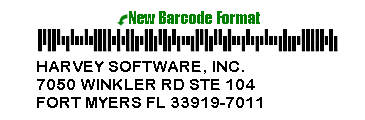
First, let’s talk about the USPS barcodes of the past.  Before implementing Intelligent Mail barcodes, USPS had POSTNET and Planet Code barcodes.  For example POSTNET barcodes would have looked something like this:


Old USPS POSTNET Barcode Example


As described above, POSTNET has been replaced by the Intelligent Mail barcode (IMb) (also known as OneCode Solution or 4-State Customer Barcode).  IMb combines all previous Postal Service barcodes and puts them into a single barcode for letters and flats.   The IMb looks similar to the POSTNET barcode at a glance, but is very different in content.  The new IMb barcodes look like this:


New USPS IMb Example


What is the right Intelligent Mail barcode for packages?


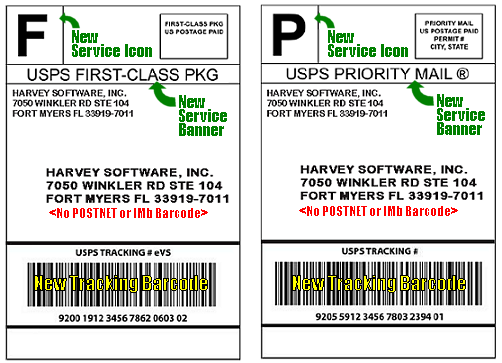
For letters and flats, IMb technology is used but this type of barcode is not used for packages.  For packages there are specially formatted labels with Intelligent Mail package barcodes (IMpb) that look like this:


New USPS Package Labels and IMpb Examples


The Intelligent Mail barcodes for letters and flats were originally required beginning May 2011, however, the USPS postponed the requirement date, allowing mailers to continue receiving automation discount rates using the POSTNET barcode after the May 2011 deadline.  We have been told that the extension has expired and the POSTNET barcodes are no longer used by USPS.

For packages, effective January 27, 2013, barcode requirements changed.  At that time, package shippers receiving discounts had to switch to the Intelligent Mail package barcode (IMpb) along with other special labeling requirements.  The IMpb and the new labeling requirements are now mandatory for all tracking and Extra Services barcodes, and includes all First-Class Package Services, Parcel Select, Parcel Select Light Weight, Bound Printed Matter, Media Mail, and Library Mail parcels in order to receive special presort and destination entry pricing.  


Without using properly formatted labels and IMpb technology, packages could be delayed as they may need to have special handling to be processed!


The new package labels have several important changes to help your packages get delivered on time.  When a USPS package moves from your business to your customer’s location, it passes through many hands and is processed by several different types of equipment.  The new labels standards developed by USPS are to insure that this happens as efficiently as possible.  Therefore, it is very important that all of your USPS labels contain all the new components and are done correctly on each and every label if you plan to get the service you expect.  

Some of the new USPS changes include things like new Service Icons so all USPS services used for packages will be easily recognized by handlers and new Service Banners, with all the correct service names, that also further reinforces handling accuracy.  Also included is the all-important new Intelligent Mail package barcode (IMpb) that should be on each and every package label so it is properly sorted and tracked.  Click here for information on the new USPS package labeling requirements using IMpb.

The new tracking capabilities alone make using the new IMpb barcodes invaluable when it comes to making sure your customers receive their holiday orders on time and they provide you with the ability to track your package if there are any delivery issues.  Click here to learn more information about IMpb barcodes for USPS packages.

For this holiday season, the IMpb barcodes and new label formats should be used for every package shipped using USPS. That is, if you want your packages to be delivered on time, at the best price and with the ability to be tracked…and who doesn’t want that?

If your current shipping software does not support the new barcode and label format requirements, we highly recommend you find a shipping system that does so as soon as possible before the holiday crunch.  

All of Harvey Software’s current shipping software that is Powered by CPS and supports USPS package services also supports the new IMpb barcodes and is fully carrier certified along with being quick and easy to install.  Our USPS shipping software solutions have options for both IMpb compliant on-line Internet postage and USPS eVS package processing for high volume package shippers.  So, if your current shipping software solution cannot be upgraded to take advantage of the new IMpb label requirements, let us help.  Click here to see our current products for options.

Tuesday, October 15, 2013

How Do I Offer Free Shipping?

Is Free Shipping Right for Your Company?
Now more than ever, all on-line stores should be looking at the marketing value of offering the right shipping choices, including free shipping, to maximize sales, market size and return on investment.  The days are over when you can just pass on the costs to the customer and expect to close the sale.  Try that with today’s savvy Internet shopper and you will lose them to your competitors!

A recent study by Forrester Research, Inc says low prices and low delivery costs are the top two reasons visitors revisit an e-tailing site, according to an article titled “Free shipping, more than fast shipping, draws consumers back” at InternetRetailer.com.   For this reason, you cannot afford to not consider using free shipping, or at the very minimum, flat rate shipping for your company.  Click here to see the Internet Retailer article.

So, the first questions should really be…

Should I offer free shipping?  Will my sales increase by offering free shipping?  How do I evaluate if free shipping is right for my company?

That is more than we can get into for this post, but a great article is titled “How to Offer Free Shipping without Going Broke”, found at WebMarketingToday.com, explores these questions with a very good discussion about deciding if free shipping is right for your company.  Click here to see the Web Marketing Today article.

We have published our own whitepaper discussing free shipping titled “Offer Free Shipping and Increase Sales” that you should download.  This whitepaper discusses many additional topics that help you decide if free shipping will help you increase sales.  Click here to download this free whitepaper on free shipping.

Knowing free shipping is not for everyone the next questions should be…

Should I offer flat rate shipping?  Will flat rate shipping increase my sales and my market size when I cannot make free shipping work?


Stop Abandoned Shopping Carts with Solutions Powered by CPS
To explore questions covering how flat rate shipping can change everything from increasing your sales to increasing the market size you service, we have also published a whitepaper on this subject, titled “Internet Retailer’s Guide to Reducing Shopping Cart Abandonment”.  Even though the title does not say it can help you with this, this is one of our most popular downloaded whitepapers and has received many comments about how a business can change just by changing how shipping costs are handled!  Click here to download this free whitepaper on flat rate shipping.

If you decide that flat rate shipping is right for your company, Shopify has a handy article titled “Shipping Rate Strategies for Your Online Store”, explaining how to effectively offer flat rate shipping at your web site to maximize its sales closing appeal.  Click here to read this article on shipping rate strategies.


Ship More for Less with CPS Smart RateBots
Once you have made the right choice concerning what is right for your company, it is time to look at the tools you will need to get the job done efficiently.  Tools like those found in all our Powered by CPS products are a great place to start.  Click here for some ideas of features you should be looking for to lower your shipping costs so you can offer the right type of shipping for your company.

So, if you think free shipping or flat rate shipping is not right for your company, there is a very good chance this is negatively affecting your sales!  We highly recommend that our readers take a careful look at all the articles and whitepapers listed above.  You will be very pleasantly surprised!

Thursday, September 19, 2013

Low Cost Shipping, Great Delivery Times with USPS


There is no question that considering several carriers’ service options for each package you ship can save money and increase your customers’ satisfaction.  With the right shipping software, this process can be easily automated. 

Likely, you also know that putting all your eggs in one basket with a single carrier can greatly restrict your ability to be competitive in your marketplace and even cause you to lose sales.  For these reasons, USPS should be one of the many carriers you consider in your decision mix.

In the past USPS shipping rates, even though they were price competitive, may have not been considered as reliable as other carriers when it came to package tracking and reliable delivery times, but that is changing rapidly.  USPS tracking is now very competitive and they are working very hard to greatly improve the reliability USPS delivery times.  For these reasons, we feel USPS is becoming a very viable choice to consider for normal daily shipping.

The following are a few reasons you should consider including USPS in your shipping choices to optimize your daily shipping needs.

Excellent Pricing for Residential Delivery and Lighter Packages is One Good Reason

For lighter packages, especially those going a residence, this is a sweet spot for the Post Office.  For the lightest shipments, those under 13 ounces, the prices for USPS First Class with USPS Delivery Confirmation are hard to beat.  Look more at their prices and you'll see that for packages over 13 ounces and up to 5 pounds or so, Priority Mail service with Delivery Confirmation is extremely competitive, especially for residential deliveries.  Plus, when you use Internet postage (or USPS eVS) to ship your packages, Delivery Confirmation for Priority Mail and First-Class is free.  Finally, use a shipping software system like those Powered by CPS and the shipping choice can be selected automatically with rate comparisons you define so you'll always get the best price for the delivery time you have chosen.  Let's face it, that's reason #1.

No Address Correction Fees is Another Good Reason

Sure, you can give the post office a package with an address to which delivery cannot be made.  But, free delivery to a forwarding address is part of their service, with no additional charges incurred.  Sometimes (granted, not every time), they even deliver a package when the address is close but not 100% accurate.  Both of these can put you dollars ahead of the additional charges for address correction you'll see from other carriers when address mistakes happen.  This is another good reason to ship with the Post Office.

This last reason is both good and bad.  No address correction fees are great for the occasional mistake, but why even chance your USPS package getting lost, over charged or mishandled in the first place?  When the right shipping software system like those Powered by CPS, address verification can be added for a very low cost and be used for every package, if you wish.  The correct addresses on your packages saves you time and money, satisfies customers with timely delivery and is best done at the time of shipping, right before the package leaves your business.

Many companies price shop each package to lower shipping costs.  The better address verification programs, like those found in shipping software Powered by CPS, tell you if the destination is a commercial or residential address so the right type of delivery service is used for price comparisons.  If you use the USPS in combination with other carriers, this becomes key to maximizing your savings on several fronts.

So, the next time you ship, make sure you consider all the options.  Do this right, and you can save hundreds, even thousands of dollars per month!  For a good example of the savings you might see by utilizing all the options when you ship with a true multi-carrier software system, visit http://www.HarveySoft.com and check out the Estimated Savings Calculator at the top of the page.  It allows you to enter in how much you ship and give you an idea of how much you can save using more than one carrier and all the right tools.


Tuesday, December 4, 2012

Correctly Documenting International Shipments for Successful, Timely Deliveries

Correctly Documenting International Shipments for Successful, Timely Deliveries

With the previously provided info regarding international customs forms in hand, what's next? Well, more information is needed, of course. It is the government, after all!  But without the correct information for customs, your packages can be stuck en route or even returned. That’s expensive and does not make your international customers smile. Our CPS Shipping Software is a multi-carrier shipping system that records this important international shipping data as well as the ability to print shipping labels and customs forms.

To complete your commercial invoice and certificate of origin forms, here are some of the items that may be needed and should always be available when shipping international packages. In addition to the value and description of your products, you should also have information about your federal id number, the country of origin of the goods you are shipping and the terms of sale.

For the commercial package carriers, you will need to provide information details about the products contained in your packages so you can provide the commercial invoice and NAFTA or non-NAFTA certificate of origin. For the USPS, for the 2976A form, you will need to decide how you want non-deliveries treated. The USPS has two customs forms, the 2976/CN22 and the 2976A/CP72. Why two designations for each form? I have never seen an explanation for that, but you may see any of these form numbers referred to by the USPS. The good news is the CPS(TM) shipping software supports both the 2976 and 2976A forms for the USPS and the Commercial Invoice and Certificate of Origin for CPS supported carriers. A good, not too complicated explanation of when each form is needed is at https://www.usps.com/ship/customs-forms.htm.

And, like most infomercials or TV product commercials, but wait – there’s more! A Shipper's Export Declaration (SED) is another form that may need to be provided.  "May need" because shipment value is part of its requirements. Starting July 2, 2008, the Census Bureau requires mandatory filing of export information through the Automated Export System (AES) or through the AESDirect for all shipments where a Shipper’s Export Declaration (SED) is required. For more information, visit this web site: http://www.census.gov/foreign-trade/www/.

Next time, we'll wrap up this international shipping information, and put a bow on it just in time for holiday shipping! If streamlining your international shipping is on your shipping department “to do” list, then check out our Web site for additional information about CPS.  Visit www.HarveySoft.com.

Wednesday, November 14, 2012

International Shipping Tips – Part 2

International Shipping Tips - Part 2

With international shipping comes customs forms creation. Maybe you do this through your shipping software, maybe you create your own forms, or you might use an online system or some other way to do this. Without the correct forms, your packages will not be delivered, so this is important. Customs forms have to meet certain specs and need to contain specific information, since most customs data must also be presented to customs electronically. This information includes a description of the goods in the shipment, their value, its classification (a merchandise sale, gift, documents only, etc.), and accurate customs Schedule B and Harmonized Tariff codes so that your packages clear customs without delays.

Since “Schedule B and Harmonized Tariff codes” are unfamiliar terms for some, below is information about the Schedule B codes from the US Census Bureau, plus some information about Harmonized Tariff codes. You can get additional information about these codes at the US Census Bureau website: http://www.census.gov/foreign-trade/schedules/b/.

Millions of trade transactions occur each year. These transactions are classified under approximately 8,000 categories of products leaving the United States and every exported item is assigned a unique 10-digit identification code. For example, concentrated frozen apple juice is assigned a 10-digit identifier that is in a broader category that is assigned a 6-digit identifier for apple juice. The 6-digit identifier for apple juice is in another broader category assigned a 4-digit identifier for fruit juices, vegetable juices, etc. The 4-digit identifier is in another broader category assigned a 2-digit identifier for Preparations of Vegetables, Fruit, Nuts etc. When you export goods, it may take some studying to learn which of these codes are the right codes for your product(s).

What's the difference between the Schedule B codes (for exports) and the Harmonized Tariff Schedule (HTS) codes (for imports)? All of the import and export codes used by the United States are based on the Harmonized Tariff System (HTS) - http://www.usitc.gov/tariff_affairs/. The HTS assigns 6-digit codes for general categories. Countries that use the HTS are allowed to define commodities at a more detailed level than 6-digits, but all definitions must be within that 6-digit framework. The U.S. defines products using 10-digit HTS codes, like the example for concentrated frozen apple juice. Export codes (which the U.S. calls Schedule B) are administered by the U.S. Census Bureau. Import codes are administered by the U.S. International Trade Commission (USITC).

The USPS uses forms called 2976 or 2976A to record and print this information. UPS and FedEx use a commercial invoice. Regardless of which form or carrier is used, your products must be properly documented or your package will sit at customs until clarification is provided. With the requirements for electronic upload of customs information, customs form creation is being tied more and more to the shipping system. Our CPS Shipping Software creates and prints the necessary customs forms; so as a multi-carrier shipping system, CPS users have one easy system for international shipping and documentation.

We'll get into more about international customs forms in an upcoming post. For more information about CPS, visit www.HarveySoft.com.

Friday, September 14, 2012

International Shipping Tips for USPS, FedEx and UPS

International Shipping Tips for USPS, FedEx and UPS
If your company is looking across our country’s borders to expand your business, a fundamental question is “How do I get the orders delivered to these international customers?” With the special regulations and additional expense of international shipping compared to domestic, getting this right is key. So understanding the international shipping process is the cornerstone to making this new business profitable and worthwhile.

Let’s look at the additional documents needed when shipping internationally. There are two (2) sets of information needed so your packages are delivered properly. One is for the carrier; the other is for customs. And this is where a multi-carrier shipping system can really help. I’ll use our CPS Shipping Software as an example.

Let's start with the most important items for the carriers. First, and it may sound obvious, but you need to know what country you are shipping to. Actually, you need to know how the carrier refers to the destination country. For example, let's use Ireland. If you are shipping with UPS, the country can be Republic of Ireland or just Ireland. For FedEx, you can only use Republic of Ireland. For USPS using Endicia, you can only use Ireland. Use the wrong one and you will not even get a shipping label. Our CPS shipping software helps with a “pull-down” country listing to assist you.

Next is international paperwork. This includes Commercial Invoices, Certificates of Origin, USPS Customs Forms and SED filings. The carrier needs to know how the international paperwork is being handled or your package can be delayed clearing customs. Each customs form has a specific layout. A shipping system like CPS that really supports international shipping can collect the data and print the correct forms in the approved format.

Using a shipping system that simplifies the shipping, shipping label, and international forms creation processes goes a long way to making international orders easy, freeing you to grow your business outside our borders.

International shipping is definitely not for the uninformed. There will be several more posts on this subject to follow over the next few weeks, including more detailed information about some of the items in the customs forms, such as the Schedule B and Harmonized Tariff codes and other items. So stay tuned.

To see more about CPS, visit www.HarveySoft.com.

Friday, September 7, 2012

An Easy Way to Emphasize Great Service and Reinforce Your Brand

An Easy Way to Emphasize Great Service and Reinforce Your Brand
“Your order is on the way.”

You received the order, you have the products in stock, and now they are on the way to your customer. So what do you think your customers expect next? If they are like most, it’s "Is my order on the way and when do I get it? Show me!" Isn’t that what everyone wants to know? And when you notify your customers with timely, accurate information about their order, you also reinforce your brand. What is the best way to do this and show your customers great service?

Shipping notifications underline your commitment to outstanding service and, when delivered correctly, emphasize your brand. A terrific way to show your customers you are giving them a great experience is to send them a timely email to let them know their package is on the way. Today's best order systems may have this feature, the carrier provided shipping systems might be able to help, and high-quality third-party shipping systems have this as an optional or (better yet) standard feature.

For example, the CPS shipping software includes the SHIP eLERT(R) that sends email shipping notices right out of CPS using your company's own email address. You don't need Outlook, Outlook Express, etc., for this. Since each SHIP eLERT comes from you instead of the carrier or another party, there is no doubt about who your customer is doing business with.

There are many more advantages to a multi-carrier shipping system than just timely shipping notifications, so consider this one point. If you use a carrier's dedicated shipping system and send the shipment notification from their system, take a look at that notification. First, it's not from your company, it's from the carrier. Also, notice how far into the notification you have to go before it's clear the notification is from your company. With the CPS shipping software, you use your company’s email address. There is no doubt the shipment notification is immediately identified as coming from your company with the information they expect to see about delivery of their order. Great service keeps customers coming back. When it’s also a better process for your company, you have the best win-win situation.

Great service keeps customers, and showing customers know how well you are serving them is a great way to encourage repeat business. For information about CPS, visit our web site at www.HarveySoft.com.

Friday, August 31, 2012

Building Your Sales with Flat Rate and Free Shipping Offers

Building Your Sales with Flat Rate and Free Shipping Offers
Part 2 - (continued from last week)

Forecasts say that online sales will grow by 15% or more this year, even in the current economy. What are the best ways for you to get your share? Reducing cart abandonment as much as possible will definitely help, as will encouraging shoppers to fill their carts. As you plan for your busy season, your shipping system can provide invaluable information to you can make your final price right for your customers. The idea is to make them click "Buy" instead of "Bye".

Shipping cost “sticker shock” is a huge contributor to abandoned shopping carts. For the same order, do you charge different amounts for shipping depending on the package destination? That makes your price different according to where your customer lives. If you visit the local outlet of a national store, they don’t ask for your ZIP code before you get the price - all customers pay the same amount. Maybe that’s a little different situation from a web store, but the point is clear - no one likes to know they are paying more than someone else for the same item. And unexpected, unanticipated shipping costs are a key factor that creates abandoned shopping carts.

“Flat rate” shipping offers, strategically mixed with "free" shipping offers, combat this problem. A number of experts and Internet entrepreneurs have found that it is very important to display shipping charges before “check out” to avoid shopping cart abandonment. So how can this be implemented?

Free shipping is very easy to calculate. Figuring out the right amount for flat-rate shipping takes a little more effort. If you are lucky enough to have your company’s actual carrier rates in your shipping system, this, combined with historical reporting directly from the shipping system, puts you on your way. Some shipping systems go a step further. As an example, the CPS Shipping Software can use actual carrier rates, including contract specific rates that even reflect the fuel surcharge, to provide the most accurate rate shopping and reporting. The CPS Flat Rate Shipping Charge Calculator report shows average shipping cost per package and average shipping cost per pound. These costs are also then reported by next day, 2 day, 3 day, ground and international services. With just a few mouse clicks you can keep tabs on your shipping costs for any period of time, by carrier and service, to accurately manage your flat rate shipping offer. This data also lets you know your costs to provide free shipping offers, too. You could crunch the numbers out of your carrier bills, but who has the time? To just "Click" and see them is so much easier. Monitor your costs at least monthly and make adjustments for changes you see in average charges.

When you look at customer satisfaction and shopping cart abandonment issues, the conclusion might be that free shipping is the only way to go. But this may not be the best approach for a couple of reasons, especially for the bottom line. Using flat rate shipping charges for low volume orders, then using free shipping as an incentive to increase the order amount are effective ways to increase sales, decrease shopping cart abandonment and increase your return customer rate. You can also offer free shipping for special times of the year like the holidays when competition is hot for consumer dollars. When implemented strategically, shipping offers lead to increased sales and profits.

Use a shipping history reporting tool like CPS Flat Rate Shipping Charge Calculator to monitor your average shipping costs and you can successfully implement and maintain flat-rate and/or free shipping offers. Quick, easily available reporting from the CPS multi-carrier shipping system lets you make sure you are accurately consider the shipping cost when using either offer.

For more information about CPS, visit www.HarveySoft.com.

Thursday, August 23, 2012

Using Your Shipping System to Take Your Sales Message Nationally, Even Internationally

Using Your Shipping System to Take Your Sales Message Nationally, Even Internationally
Is one of your goals to be a national or even international seller? Is this the message you give shoppers at your web site? If you have not yet established flat rate shipping charges for your orders, you could be sending the wrong message. This is an ideal time of year to look at how you are charging for shipping and making sure to deliver the best message to maximize your sales. If you charge for shipping based on the shipping cost for individual orders, your closest customers get your best price, turning your national ambitions into a local or maybe regional business. And everyone wants the biggest possible potential customer base.

It’s well established that unexpectedly high shipping costs are a major contributor to abandoned shopping carts. If you calculate shipping costs per order instead of using flat rate shipping prices (or even free shipping for promotional seasons), you run the risk of causing shipping cost “sticker shock”, and there’s another abandoned cart. So how do you get around this?

Consider developing flat rate shipping cost offers for ground service and do the same for expedited (air) service. With flat rate shipping offers, you tell your shoppers the cost of shipping “up front” so they can fill their carts with confidence, ready to click the “Buy Now” button. Flat rate shipping offers can also simplify the work needed to maintain shipping prices that are displayed on your web site, another welcome benefit. This takes some work and thought to develop, then monitor on a weekly/ monthly basis to determine if adjustments are needed. But there is a great reward - more filled carts and more sales.

A related topic is international sales. International sales can be a business builder, but many see international shipping, with its complexities and regulations, to be a substantial barrier. Commercial invoices, US Postal Service forms and other required international paperwork and regulations (some backed with stiff penalties) mean you need to become an expert in shipping your products overseas.

What do flat rate shipping and international shipping have in common? Each of these can be made easier with the right shipping system. Harvey Software’s CPS Shipping Software helps with each task. The CPS Flat Rate Shipping Charge Calculator provides instantaneous access to the shipping data needed to establish and monitor your pricing for flat rate shipping. And CPS supports international shipping, including customs forms, international rates and shipping labels. The right multi-carrier shipping system can definitely help increase your sales.

Next time, part 2 – more about discovering the right "flat rate" price to charge for your shipping. To find out more about CPS now, visit www.HarveySoft.com.

Friday, August 17, 2012

What's Next When You Suspect Theft in Your Shipping Department?

What's Next When You Suspect Theft in Your Shipping Department?
How often do you check to see if your packages are delivered to the right address? Of if they even make it onto the carrier trucks. And if this is not happening, what to do next?

Re-labeling packages, shipping packages that don't belong to your company, changing addresses, deleting packages - all of these can happen and have happened. You might have years of trusted service from a key employee, you check references, do background checks, put systems in place, but something doesn't seem right. You seem to have too many orders that need to be reshipped. Or your shipping costs seem high according your shipping budget forecast of shipping X number of boxes that weigh Y pounds. This kind of problem can be hard to pin down, even when you see the "red flags" that you are sure mean you have a problem. Here's where a shipping system might help you.

In the CPS shipping software, you have quick access to your shipping history data so you can search and analyze your shipping information. For example, after recently noticing something "wasn't right" with their shipping, one CPS shipper extracted their shipping data, looked for patterns that did not match their normal shipping, and discovered there was no order ID information with some of their shipping records. More research into these records zeroed in on the problem and helped find the employee responsible. In another instance, shipments of already processed and labeled packages were voided, then the addresses were altered at the time of shipping. Even though the shipments were deleted in CPS, the labels with illicit addresses were already printed and the package given to the carriers for delivery. With a special setting, CPS wrote the data for every voided package to a file for monitoring. Following this trail of voided packages then led back to the person who was scamming the company. These are examples of looking at the problem "after the fact".

To stop a problem before it happens, one way is to use a data lookup to read the shipping data into CPS, then prevent the shipping system operator from changing or voiding the address in the shipping system. In CPS, there is a setting so if the shipper tries to edit the shipping address fields, a window pops up requiring a password in order to make any change.

It's hardly ever possible to watch what happens to every package in your shipping department. Tools in your shipping system like these in CPS give you the power and information to stop these problems if they occur, or even before they occur.

To find out more about the CPS multi-carrier shipping system, visit our web site at www.HarveySoft.com.

Friday, August 10, 2012

Back Up Your Shipping System and Cover Your A$$ets

Back Up Your Shipping System and Cover Your A$$ets
Backing up computer data is BOR-ING. Even thinking about backing up computer data is boring. But a good backup for a critical business system such as a multi-carrier shipping system can be a business-saver. That's why I wanted a "get your attention" headline. The worst thing you can hear (or say) at the start of your shipping day is "Uh Oh", followed by "Do we have a backup?" Suddenly the computer backup is not so boring.

Computers can fail without warning and at any time. So what can you do? Buying a good computer, using a capable Uninterruptible Power Supply (with voltage regulation), always using the computer’s "Shut Down" feature when you turn it off and not bumping (or intentionally smacking) the computer are at the top of the list. But, in spite of everything you can do, computers fail. With their mechanical and electronic parts, it's not "IF", it's just "WHEN". So what's the best plan to keep you shipping?

Setting up a reliable backup may be easier than you think. The standard options are to backup your data to another computer at your site (a "local" backup), backup your data to a remote location using your network, or use an online service (you might see ads for Carbonite.com and Symantec online backup services). There are programs designed to automate backing up, or you could even use the Windows Explorer to copy files from one computer to another for safekeeping. Whatever you decide, there are solutions out there to help keep your data safe.

For your shipping system, look for a program that helps you safeguard your data. Our CPS shipping software includes a built-in backup utility to save those important shipping system programs and data. This built-in backup works every time a CPS session is ended, providing additional peace of mind.

Since we concentrate on shipping systems and our multi-carrier CPS shipping software in particular, we know there are choices. You could use an Internet-based shipping system that only needs a browser to work, but many of the browser-based systems work too slowly for volume shippers. That's why we're looking at backup basics for a shipping system like CPS that runs on your own computers.

Keep in mind you can lose data directly, like computer failure, as well as indirectly, such as a power failure, files that are deleted accidentally (or otherwise, but that’s another blog), plus other factors. A current backup can save the day. And we strongly suggest using a battery backup for the shipping computer. If you have a problem, have a system in place that can save the day. Use these tips and be ready.

For more information about CPS, visit our web site at http://www.HarveySoft.com/.

Friday, August 3, 2012

Making the Most of Carrier/USPS Hybrid Services

Making the Most of Carrier/USPS Hybrid Services
This might become the year of the hybrid delivery services. What is a “hybrid” service? No, it’s not a package delivered only by an electric car. The hybrid services are those that involve pickup and billing by the carrier while using the US Postal Service for final delivery. The rates can be attractive, especially for lower weight packages that are being shipped to residential addresses. But how do these services work and how are they different from the other carrier services?

Generally, there is a contract with the carrier for the hybrid services. The contract might include information about when and how the packages will be picked up, what package weights can be shipped, obviously your rates for the hybrid service, plus other aspects of the service as it applies to your business. In addition to the contract terms, be sure to find out where your packages will go after they leave your door. The carrier aggregates packages shipped with the hybrid service then transports them to the post office location that will make the final delivery. How far a package has to travel during the aggregation process can affect the ultimate delivery time. How long it takes for package delivery can definitely affect your customers’ satisfaction with your company. Also, check the carrier’s liability for these packages. It may be a lower coverage limit than their standard delivery services or there might not be any package insurance available at all.

After you are satisfied that the service will be beneficial for your company, the next step is to decide on the shipping system that will work best for the hybrid service. To use the hybrid services to their best advantage, a multiple carrier shipping software system really makes the difference. Here is how this works in the CPS shipping software.

Since CPS provides the ability to ship with multiple carriers, including hybrid services for both FedEx and UPS, you are able to take advantage of the RateBot feature in CPS to ensure that the most efficient and economical choice is made automatically according to business rules you create. CPS also maintains the rates for the carriers and services used for shipping. This means you can use the hybrid service any time you want it, plus you can use “best rate and service” shopping tools so that CPS can make the best selection automatically. You can instantly ship any package with any carrier or service, so you control your shipping process including how much you pay for each package. Adding this aspect to the hybrid services puts you firmly in charge of your shipping, which is important more than ever today where EVERY dollar counts.

Consider all of these aspects when you are investigating the hybrid delivery services and you can come out ahead with every package. For more information about our shipping software solutions, visit http://www.HarveySoft.com/.

Friday, May 18, 2012

New FedEx Capabilities Highlight Latest Update for CPS Shipping Software

New FedEx capabilities highlight latest update for CPS Shipping Software
The latest update for the CPS Shipping Software marks the first major update for CPS to support new technology from a carrier. This update lets CPS support FedEx Web Services package processing. This update increases package processing speed and opens new services and service options for CPS users.

Speed has always been a priority for processing all packages, including FedEx shipments, in the CPS shipping software. While incorporating this new FedEx technology into CPS, the programming group made a fast shipping system even faster with this update – a feat that took considerable ingenuity. Speed is not all that’s been added. This update includes a variety of new features and capabilities that enhance FedEx shipping, including: FedEx SmartPost® service now available and supported as a CPS Premium Module option; the special setup to print FedEx Express labels is no longer required - the Windows print system with appropriate Windows printer driver can be used to print FedEx Express, Ground, Home Delivery and SmartPost labels; the Signature release option for international shipments is more conveniently consolidated into Signature Confirmation options; the Hold At Location service for Canada is added; support for the FedEx Priority Alert service is added; Payment of Duty/Tax by Receiver for international shipping now validates the FedEx account number, if entered; and multi-piece FedEx Standard Ground shipping to Canada is supported. That’s a lot to add!

The FedEx SmartPost service is a FedEx/USPS “hybrid” service targeting low weight residential delivery. By supporting SmartPost and other “hybrid” delivery services, CPS continues to present shippers with the best, most cost effective shipping options for all of their packages. The number of companies looking for the best and least expensive alternative ways to ship lighter packages, especially to residential addresses, is growing and CPS puts its users in the driver's seat.

With increased shipping speed, expanded services, enhanced international shipping options and numerous other improvements, we think you will be more than pleased with what CPS now offers in providing the latest shipping technology in a multi-carrier shipping system.

For more information about CPS, visit www.HarveySoft.com

Friday, April 13, 2012

Low Cost Custom Auto Part Shipping

Shipping Custom Auto Parts Retailer
Classic cars are a huge passion to many Americans. Have you ever wanted something your car didn't come with or to make your special car look a certain way? The search for custom parts and even replacement parts just got easier with the internet. Now many of those parts vendors have pretty cool websites like CHEVYMALL (http://www.chevymall.com/) or West Coast Corvettes (http://www.westcoastcorvette.com/) where you can find almost any part that your heart desires. Now getting those parts that the customers purchase to them easy and fast is where our CPS Shipping Software comes in.

Classic Corvette CarThis is a competitive market and margins are thin. Any advantage you can get by reducing shipping costs to you and your customers helps increase those profits. It could also mean the gain of a sale by your shipping costs being cheaper than your fellow competition. This is where multi-carrier shipping software pays off - by comparing carrier rates for every package quickly and easily. The Computerized Parcel System (CPS) will rate shop between major carriers - FedEx, UPS, USPS and even the hybrid services.


Classic Corvette LogoThat is not all the CPS Shipping Software does. One important thing that online vendors need is branding. CPS has an email notification system that helps small websites build its brand into loyal, long-time parts customers which is essential for your company. Another key point is that CPS speeds up the processing of orders cutting down the amount of time it takes per shipping package turning the company into like a well tuned car.

Classic Chevy BelAir This is just one example of how multi-carrier shipping software can help with an online parts vendor's business. Shift your business into high gear and checkout http://www.HarveySoft.com/ today.


Cars photographed were provided by Classic Cars of Florida (http://www.ccofl.com/).

Classic Chevy Bell Air Logo

Friday, March 23, 2012

Profiles of Multi-Carrier Shipping System Users: Small Online Retailer

Profiles of Multi-Carrier Shipping System Users: Small Online Retailer
In many ways, the small online store has taken the place of the family-owned small corner store. Some of the best shopping websites are actually based around a store that used to operate strictly locally. A crafter may sell handmade items from a brick and mortar storefront and the addition of a website makes those products available around the world. Others websites evolved from online auctioning that got big enough to go independent from the auction website. Online stores are often owned and operated within a family, while others become family-like with a tight-knit operation and everyone pitching in to achieve the business’ goals.

Of course, the definition of “small” lends itself to many definitions. There can be anywhere from one to a couple of dozen employees. Sometimes that store produces the items it sells and sometimes it operates as a middleman between the manufacturer and the consumer. Often, these stores choose a specific theme and niche to focus on their market. The key factor that these stores have in common is that they are advertising online, selling online, and delivering products to their customers directly. Every service available in large online megastores is also expected of this small retailer, including a shipping system that ships their packages quickly with package visibility for their customers.

In the shipping department specifically, small online retailers typically ship up to a hundred packages a day. This retailer needs to be able to ship anywhere in the world, since each order is valuable and happy customers who receive their order in a timely manner are essential to build the brand and spread the word about the website. After orders are received and payment collected, getting those orders out the door is the highest priority. This is one reason why multi-carrier shipping software is so essential for this small retailer – the shipping department needs to know the best way to send a package in the time frame needed. A good multi-carrier shipping system obtains that information instantly and accurately. In addition, the right shipping software will connect to shopping cart and order management systems to make sure data is entered only once.

The web is a great equalizer, allowing an attractive, efficient, informative website for a small retailer to look and work as well as the largest online sellers. Modern shopping cart software makes this marketing possible and that online storefront is accessible to anyone with a computer. After great marketing gets the order, the final step is the right multi-carrier shipping system to allow those same small retailers to get competitive shipping rates to around the world. With connectivity to their order data, fast parcel processing, and features to increase customer satisfaction, Harvey Software’s CPS shipping software is a great shipping option for the small online retailer.

Friday, January 27, 2012

Series Introduction: Shipping System Profiles

Series Introduction: Shipping System Profiles
A batch of orders arrives, and employees work quickly to get those packages out the door. Other tasks are moved to the back burner until these orders are shipped. Those customers will be happy customers when they receive their packages on time and (hopefully!) this process is repeated regularly. When you ship enough, it’s easy to see that the only items changing on each package are the name, address, and weight. Multi-carrier shipping software helps organize this repetitive process plus offer the BEST rate for each package that goes out. This allows carrier competition to work for shippers.

There are three goals of all business software:

1. Increase Productivity
2. Reduce Costs
3. Simplify Organizational Processes

All three of these goals are achieved in the shipping department by using multi carrier shipping software. Increased productivity comes from reducing the workload required for each package. Reduced costs come from rate shopping between parcel carriers for every package. Simplified organizational processes are realized when you connect the shipping system with other business applications, making data portable and easily available to all functions of the organization.

Using dedicated shipping software will achieve these goals for all types and sizes of companies. For a small online vendor or local crafter, every employee wears multiple hats. You want the shipping process to be quick for each package so that you can spend your time on other work. For a large online vendor, you want to be able to utilize barcode order entry and ship each package with one or two keystrokes or mouse clicks. For a food vendor, you want to be able to choose from multiple express services at a glance to get the products from “fresh” to table as quickly as possible. For a fulfillment company, you want to be able to ship using multiple customer account numbers with multiple carriers and lower the charge per package to the minimal amount necessary. All of these specific needs relate directly to the three main goals above. Every feature of a shipping system should reach back to those goals and make work easier for the company using the system.

All of the above company profiles have differing volumes and shipping needs, but believe it or not, all can benefit by using the right shipping system. Harvey Software’s CPS shipping software is the versatile solution that covers all of the bases. CPS features are customizable to allow a shipper to create the order entry process they need, increasing the productivity of every employee involved in shipping. Rate optimization features and up to date carrier communication allows carrier competition to keep shipping costs as low as possible. Customer data can be read from and completed information written to any ODBC compliant accounting or order management system, allowing customer service to have visibility into shipping services used, tracking numbers, and shipping costs.

Over the next ten weeks, we’re going to profile different types of businesses that can take advantage of a multi-carrier shipping system. As we highlight each of those shipping profiles, you will learn why a multi-carrier shipping system can improve the shipping process in almost any type or size of business. Look for specific ways that shipping software like Harvey Software’s CPS can accomplish those three goals that every business desires. To see more information now, visit our website at www.HarveySoft.com or call us at 1-800-231-0296.

Friday, January 13, 2012

Who Works for Who? Is Your Shipping System Working for You, or Are You Working For Your Shipping System?

Who Works for Who? Is Your Shipping System Working For You, or Are You Working For Your Shipping System
In the movie Cast Away, the opening sequence times a package from Seattle, WA. to St. Petersburg, Russia. Tom Hanks’ character Chuck travels to Russia to analyze the package in which he placed a stopwatch before sending it to himself. He shows the FedEx employees in Russia the timer. Thirty-two hours from Seattle to St. Petersburg – 9000 miles. Forty-one hours from the warehouse to the destination – 4 miles. He certainly found the source of the problem. And then he begins working every job in the facility in order to improve efficiency. Though the audience never sees the results of his efforts, it’s easy to assume that things got better soon after Chuck’s visit.

How many shipping systems out there are “good enough?” How many employees are doing what’s basically a workaround solution but needs improving? Make sure that your shipping software is not a bottleneck to your shipping process. If it takes more than a minute to go from reference number to label printing, there are likely ways to improve upon that process. Make sure that data entry and write-backs are happening automatically. Make sure that your employees are aware of procedures for international packages, packages that need insurance, and packages that require return labels. And definitely make sure that you are getting the best rates possible from the carriers, for every package you send.

I spoke with one of our current customers who recently switched over to using our CPS multi-carrier shipping software, and I was surprised to hear that he was doing his own rate shopping between carriers before he began using our software. He did have shipping software hooked up to his order management system to pull data from, but that shipping system only showed rates for one carrier. He is smart enough to know that the carriers were already competing with one another, and he would systematically check another carrier’s website for their rates, for each package he sent. His determination to save money for his business is admirable. At the same time, he was spending an incredible amount of time looking up rates by hand, a process that can be completely automated. We were able to set him up with a shipping system to compare FedEx, UPS, and USPS rates simultaneously, and he was even able to set up custom business rules that allowed the system to select the lowest rate automatically for the services he prefers.

Harvey Software’s CPS shipping software can do all that’s spoken about above and more. With the flexibility of this multi-carrier shipping software, the application possibilities are endless. Contact us today at 1-800-231-0296 or visit www.HarveySoft.com for more information.