 Would you like to save over 10% on your air shipping and almost 1½% on you ground shipping? It doesn't look like there has been much notice about this yet, but on December 1st, the fuel surcharge for the two largest package carriers will drop significantly for both ground and air service. If any of your shipping can wait until that December 1st pickup date, you will be charged a lower shipping rate due to the lower fuel surcharge. So, if you absolutely, positively have to ship a package before Thanksgiving, then it's got to go. But if you can wait for that Monday pickup, the savings are significant. This could mean the difference between a good and great holiday sales profit!

Monday, November 24, 2008
More Profits for Companies that Ship in December
Would you like to save over 10% on your air shipping and almost 1½% on you ground shipping? It doesn't look like there has been much notice about this yet, but on December 1st, the fuel surcharge for the two largest package carriers will drop significantly for both ground and air service. If any of your shipping can wait until that December 1st pickup date, you will be charged a lower shipping rate due to the lower fuel surcharge. So, if you absolutely, positively have to ship a package before Thanksgiving, then it's got to go. But if you can wait for that Monday pickup, the savings are significant. This could mean the difference between a good and great holiday sales profit!


Friday, October 24, 2008
Looking at International Packages Damaged in Customs
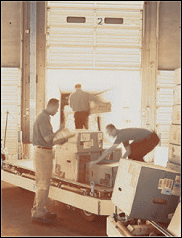 Recently we had a shipper neatly roll up and send photographs from the US to Canada using a large Mail Tube. When the photographs arrived at their destination it was discovered that the tube had been opened and the photographs had been folded into thirds and placed back in the tube. Naturally this destroyed the photographs. With some investigation we discovered that the tube had been opened in Customs and that was where the pictures had been folded and placed back in the tube. But that was not the end of the problems for the shipper and recipient.
Unfortunately the recipient did not save the tube. When they made the claim for the damaged contents, they were unable to collect for damages in Canada. This left the shipper to deal with our carrier of choice, and they eventually received an amount that covered only some of their costs.
Hearing all this made us think, “Is there a difference between shipping internationally with all the different carriers when it comes to dealing with customs damages?” The following is what one of the commercial carriers told us during our investigation:
“Any Customs officer can open any package they choose regardless if it is an export or import. The only exceptions are diplomatic bags/pouches. The difference between shipping with us is the fact that one of our employees opens the package and reseals it, where with other carriers, the Customs officers works alone. In the case of our package, should the contents be damaged by a Customs officer, our employee will notate it and the customer (be that consignee or shipper) will have recourse with the government to file a claim.”
The good news is we were also told by this carrier that this does not happen very often. At least for them, in all cases where it did happen they noted that the Customs officer included a claim procedure inside the package. (Something our shipper in the above example did not have happen.) The alternate carrier did say that the Customs officers generally are very respectful of the contents and do take care not to damage goods.
After our investigation we have found that there is a difference. We must package our international shipments so they can be easily inspected by Customs regardless of carrier. We must be aware that there is a difference in how your products could be handled and you should check with your carrier representative to know for sure. We have been told by several industry people that the inspection rate is about 6 percent for Canadian shipments although the government has mandated 10 percent. More on this subject can be found at the links below or at your carrier’s web site:
United States Customs: http://www.cbp.gov/xp/cgov/trade/
Canada Border Services Agency: http://www.cbsa-asfc.gc.ca/
Thursday, October 16, 2008
We Always Use the Post Office...It Costs Less…Or Does It?
 We hear this phrase almost daily any more. And yes, many times this is a true statement, but our CPS customers are finding out that this is a very bad assumption. In fact, using only one carrier to ship your products can result in much higher costs than you could ever realize even if you are shipping only a few packages per week!
A good example of this is when one of our employees recently decided to ship a large flat box that weighed 4 pounds. Like many of our customers, he first checked the rates for shipping it using USPS Parcel Post because he incorrectly assumed that they were the cheapest. He found that the cost was $63.23 because of the package dimensions and it would be delivered in 2-9 days. This seemed very high since the shipping cost was nearly as much as the value of the product. He then decided to let CPS shop for the best price and service. To his surprise he discovered that by using standard UPS Ground rates the same package would be delivered in 1-5 days and would only cost $12.81. This is a cost savings of $50.42 for a single package!
So you say, I will look at each thing I ship and determine the best way. After that I will always use the best way I discovered when I ship that item. This is another false sense of security concept. With things like fuel surcharges and prices changing constantly the results of this decision can be costly, too. This points to the fact that automated systems for doing pricing on a box by box basis optimizes savings and is your only real choice to keep from over-paying in today’s fluctuating economy.
If you want to minimize your shipping costs and maximize your profits on every box you ship, you need to have access to multiple carriers and shop between them for each and every parcel. This is especially true when you receive carrier discounts because this, too, can have varying results depending on many factors. The savings you will receive by employing the right tools will easily pay many times over for any solutions needed to get this done in an automated fashion.
Tuesday, September 23, 2008
Carrier Fuel Surcharge Opportunity for the Holidays
 With all the negative economic issues affecting retail buyers today, many companies are questioning how holiday sales will be this year. We feel that despite an overall retail sales decrease, Internet sales will be higher for 2008. We also feel that these sales will be spread over many more retailers than in years past. For many it could be tough. Many retailers who did not sell on the Internet in past years are now turning to Internet retailing as a way to increase overall retail sales. Many of these are huge, well funded companies. The reason for all of the interest is mainly due to energy costs. Experts feel that more buyers will be shopping from their PCs rather than driving to stores in 2008. With many more established Internet retailers creating a much more competitive market this holiday season, everyone will need to be more innovative to survive.
Keeping this in mind, we have noticed in the last week that the major carriers have announced a decrease of their current fuel surcharges, starting October 6, 2008. This decrease in cost could be an opportunity for you to increase your company's sales right now. With the uncertainty in the energy market, it's possible these prices may not be around very long. To see examples of the decreases, you can visit the UPS and FedEx Fuel Surcharges links on this Blog page.
Now you ask, "How can I benefit from this carrier fuel surcharge decrease?" That is easy. You need to focus on offering deals to your visitors to purchase heavily from your web site during the month of October.
Offering a lower flat-rate (or even free) shipping for volume purchases is a great special to take advantage of this opportunity. If you are a CPS user, now is the time to use your Flat Rate Report to help you determine the right strategy for flat rate or free shipping. We feel this is a good time to get a jump on the holiday market before the fuel surcharges increase again. Let's face it - the odds are in favor of them going up again. And if that's wrong, you still got a jump on 2008 holiday sales.
Wednesday, September 10, 2008
New International Shipping Document Requirements Mandatory for October 1, 2008
 Back in June, we wrote about an upcoming change effective July 2, 2008, that the Census Bureau would require mandatory filing of export information through the Automated Export System (AES) or AESDirect. This is for all shipments where a Shipper’s Export Declaration (SED) is required. Beginning October 1, 2008, the "adjustment period" is over and there are fines and potentially prison time if these filings are not filed accurately and on time. The fines and prison time are significant - up to $10,000 and 5 years per shipment.
Some history-
The changes are in the Foreign Trade Regulations (FTR) that affect the Shipper’s Export Declaration (SED) (now known as Electronic Export Information - EEI) procedures. The new Regulations became effective July 2, 2008. By October 1, 2008, if EEI is required for a U.S. export, the EEI must be electronically filed to the Automated Export System (AES) by the U.S. Principal Party in Interest (USPPI) (normally this is the exporter) or their designated agent.
There are more rules about when EEI is required than can be covered well here. UPS, FedEx and the USPS want different information about EEI, some of the exemption numbers have changed, and there are many other requirements. Be sure to contact your carrier(s) so they can advise you about how to comply with this new requirement. The USPPI can file for themselves directly with AESDirect. You may also find that the carriers offer other filing method options.
You will find additional information about this at the U.S. Census Bureau web site.
Tuesday, September 2, 2008
Handling Carrier Strikes and Other Service Disruptions
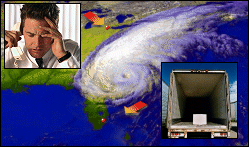
Recently, the 12,000 member Teamsters Local 705 in metro Chicago authorized a strike against one of the major carriers. Although an agreement was reached just hours before deliveries stopped, it reminded me that there is another important aspect of a multiple carrier shipping system - carrier choice. Sure, carrier choice in your shipping system gives you the best price for each package and more negotiating power with the carriers at contract time. But "best pricing" is in second place compared to making sure your packages get shipped.
Labor problems are not the only reason a carrier may stop picking up your packages. What about weather like hurricanes and winter storms? If a carrier stops picking up your packages, whatever the reason, you need to do something immediately. If packages aren't flowing out, then money is not flowing in. Even a one day interruption is disruptive, and you never know when it will be over until it's over (with apologies to Yogi!). If you miss just one shipping day, you could be facing expensive service upgrades when you ship the next day to you meet promised delivery times.
When an interruption becomes extended, history tells us other carriers may not even accept new customers to prevent overloading and poor service to their current customers. Even if you have selected a "primary" carrier, consider giving another carrier some packages each week so you have an alternate carrier available if the worst happens. As an example, with the CPS shipping software, you simply change the three carrier initials and you are immediately shipping with your alternate carrier, printing carrier accepted labels and sending them accurate data for billing and tracking.
Strikes, weather, etc. are "worst case" situations, and a shipping system with carrier choice can do more than just save money, it could save your business.
Labor problems are not the only reason a carrier may stop picking up your packages. What about weather like hurricanes and winter storms? If a carrier stops picking up your packages, whatever the reason, you need to do something immediately. If packages aren't flowing out, then money is not flowing in. Even a one day interruption is disruptive, and you never know when it will be over until it's over (with apologies to Yogi!). If you miss just one shipping day, you could be facing expensive service upgrades when you ship the next day to you meet promised delivery times.
When an interruption becomes extended, history tells us other carriers may not even accept new customers to prevent overloading and poor service to their current customers. Even if you have selected a "primary" carrier, consider giving another carrier some packages each week so you have an alternate carrier available if the worst happens. As an example, with the CPS shipping software, you simply change the three carrier initials and you are immediately shipping with your alternate carrier, printing carrier accepted labels and sending them accurate data for billing and tracking.
Strikes, weather, etc. are "worst case" situations, and a shipping system with carrier choice can do more than just save money, it could save your business.
Friday, August 29, 2008
UPS® Has Issued a New Sustainability Report
 One day after our Blog posting on “How You Can Save Oil”, UPS released its sixth annual Corporate Sustainability Report with progress reports on the company's economic, social and environmental performance. The report is posted at sustainability.ups.com.
Of special interest to those that are looking at their shipping impact on foreign oil use visit the Environmental Section (PDF).
Subscribe to:
Posts (Atom)